Monday, 1 August 2016

Mexican Banks Tighten Lending to States as Graft Concerns Surface

Mexican Banks Tighten Lending to States as Graft Concerns Surface

FILE - Mexican Finance Minister Luis Videgaray (C), Mexico's Economy Minister Ildefonso Guajardo (R) and Deputy Governor of the Bank of Mexico Roberto del Cueto attend a news conference in Mexico City, Mexico, June 24, 2016.

FILE - Mexican Finance Minister Luis Videgaray (C), Mexico's Economy Minister Ildefonso Guajardo (R) and Deputy Governor of the Bank of Mexico Roberto del Cueto attend a news conference in Mexico City, Mexico, June 24, 201

Mexican banks, determined to avoid a return to past woes, are reining in lending to the country's indebted state governments, some of whose leaders have recently become the focus of corruption allegations.
The drop in bank lending to the states this year has been the sharpest since the 2007-2009 financial crisis, and coincides with a jump in liabilities in several states in the past five years.
In the first half of 2016, commercial banks agreed 11 loans to local and state governments worth 8.471 billion pesos ($451 million), less than half the sum from the same period in 2015, when 32 loans went out, according to finance ministry figures.
This year's decline was the steepest since 2009, when the financial crisis pushed Mexico into recession, the data show.
Four states — Veracruz, Quintana Roo, Nuevo Leon and Chihuahua — accounted for close to half of the 70 percent jump in local government liabilities between 2010 and 2015, which stood at 536 billion pesos ($28.52 billion) at the end of December.
"We now have more cautious policies to avoid cases of over-indebtedness," said Armando Acevedo, the executive in charge of local lending at Grupo Financiero Interacciones, a major lender to states and municipalities.
In June, Moody's downgraded GFI's ratings, citing "rising asset risks deriving from the bank's large exposures to Mexican regional and local governments."
And over the next six weeks, Moody's did the same to Veracruz and Chihuahua, while Quintana Roo, home to tourist hub Cancun, had its outlook lowered by Standard & Poor's.
Mexico has suffered two major financial crises in recent decades — in 1982 following a national default, and in 1994-1995, which was accompanied by a sharp currency devaluation.
The Mexican government insists there is no problem, and a law passed in April means lending rules are now tighter.
"I detect a much more analytical banking sector," said Marcela Andrade, head of the Finance Ministry unit responsible for coordinating with local governments. "It's more obvious they're looking more at who they lend to."
Political fallout
Banks insist they are not retreating from regional borrowers, which are dominated by the 31 states and Mexico City.
"What we have done is be much more careful about which states we're lending to," said Luis Robles Miaja, board president of BBVA Bancomer in Mexico.
Another top Mexican financier, speaking on condition of anonymity, told Reuters that he was seriously concerned about corruption and financial mismanagement in states including Veracruz, and had sought to reduce his exposure.
Signs of retrenchment are evident.
Between December 2015 and June 2016, commercial banks' total outstanding loans among states and municipalities dropped 3.1 percent to 324.3 billion pesos, according to central bank figures. In contrast, their loans to the private sector rose 5.6 percent to 3.477 trillion pesos.
Local governments account for a small fraction of total liabilities, but allegations of corruption have been punished by voters in the four states at the center of debt concerns.
Ruled by President Enrique Pena Nieto's PRI going into 2015, Veracruz, Quintana Roo, Nuevo Leon and Chihuahua have all since fallen to the opposition, which has accused the outgoing governors of fraud or embezzlement. They deny the allegations.
There are even fears some states could need a bailout.
"Veracruz is broke," said Armando Rios Piter, senior member of the Senate finance committee in the center-left opposition Party of the Democratic Revolution, which captured the state in coalition with the center-right National Action Party in June/

Clinton, Trump Swap Insults as Presidential Campaign Heats Up

Clinton, Trump Swap Insults as Presidential Campaign Heats Up

FILE - Democratic presidential candidate Hillary Clinton gets off her campaign bus as she arrives for a rally at K'NEX, a toy company in Hatfield, Pa., July 29, 2016.

FILE - Democratic presidential candidate Hillary Clinton gets off her campaign bus as she arrives for a rally at K'NEX, a toy company in Hatfield, Pa., July 29, 2016
.
Sunday is a traditional day of rest -- but not if you are running for president of the United States.
Democratic candidate Hillary Clinton was in Columbus, Ohio, the last stop on a three-day tour of Ohio and Pennsylvania -- two industrial states political experts say are going to be key battlegrounds in the November election.
"Donald Trump poses a serious threat to our democracy," she told the crowd, urging people not to listen to what she called her Republican rival's rhetoric and demagoguery.
Clinton visited factories in the two states where she said hard-working Americans are "still making things," and said Trump should be ashamed of using factories in places such as Mexico, Slovenia, and Bangladesh to make products with the Trump name on the label.
Clinton admitted she is up against "powerful forces," but did not refrain from telling the audience that the wealthy and Wall Street will "finally pay their fair share of taxes" to pay for her plans to create new jobs.
Meanwhile, Trump is charging the Democrats with rigging the debate schedule in September and October so that two of the three debates are held at the same time as National Football League games.
FILE - Republican presidential candidate Donald Trump speaks during a campaign rally at the Wings Over the Rockies Air & Space Museum, in Denver, Friday, July 29, 2016.
Football has a fanatical following in the United States and could attract a bigger television audience than the debates.
Trump initially told ABC television's This Week broadcast that the NFL sent him a letter complaining about the schedule. But after the NFL denied sending a letter, a Trump aide said the candidate learned of the conflict from "a source close to the league."
The non-partisan Commission on Presidential Debates says it began working more than a year and a half ago to pick suitable dates to avoid other big events and religious holidays. It says it is impossible to avoid all sporting events.
Trump holds campaign rallies Monday in two of the cities Clinton just visited -- Columbus and Harrisburg, Pennsylvania. Clinton will be in Omaha, Nebraska and Boulder, Colorado
While Trump boasts that television ratings showed more viewers watched his nomination acceptance speech than Hillary Clinton's, Clinton got a seven point post-convention bump in the polls.
The Morning Consult organization reported Sunday that Clinton leads Trump in voter preference 43 to 40 percent. Trump enjoyed a similar bump after the Republican convention and he briefly led the polls.

Friday, 22 July 2016

Clinton Chooses Virginia Senator Kaine as Her Running Mate

Clinton Chooses Virginia Senator Kaine as Her Running Mate
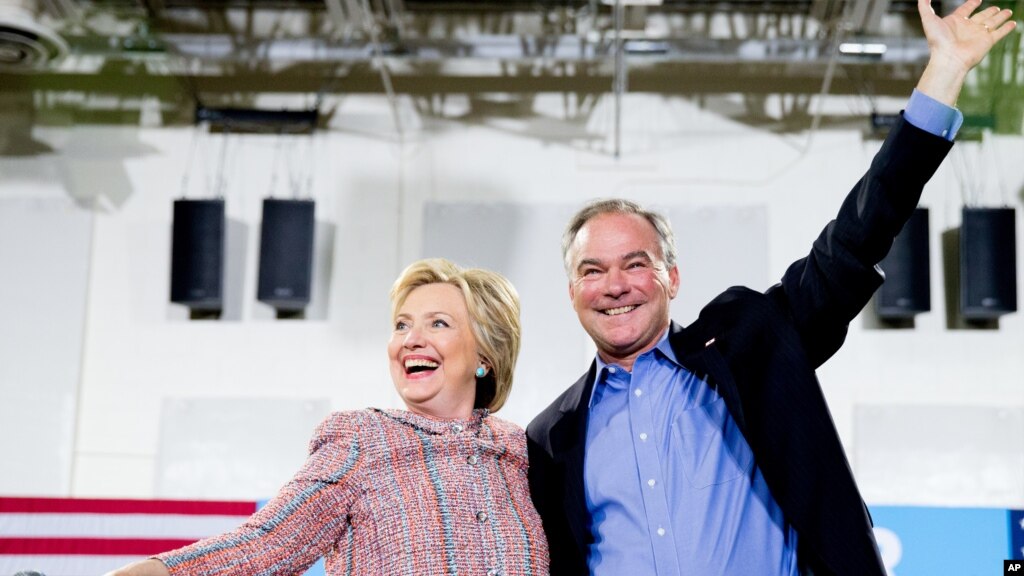
Democratic presidential candidate Hillary Clinton and Sen. Tim Kaine, D-Va., participate in a rally at Northern Virginia Community College in Annandale, Virginia, July 14, 2016.
Democratic presidential candidate Hillary Clinton has named Virginia Senator Tim Kaine as her vice presidential running mate.
Kaine is a veteran Democratic politician who describes himself as "boring." He also is a moderate who has the potential to attract voters repelled by Donald Trump and those who may have a hard time fully embracing Clinton.
"He's never lost an election. He was a world-class mayor, governor and senator and is one of the most highly respected senators I know," Clinton told CBS news.
Kaine wrote in a Twitter message that he was honored to have been chosen and that he "can't wait to hit the [campaign] trail" Saturday in Miami. He is expected to appear with Clinton at a University of Miami rally.
Kaine, 58, was born in Minnesota and is a Harvard-educated lawyer. Harvard is the same law school that turned out President Barack Obama.
But Kaine took a year off from Harvard to work as a Catholic missionary and teacher in Honduras.
According to his biography, Kaine observed poverty up close up in Central America and saw what it can do to the human spirit. His time there is said to have helped form his support for citizenship for undocumented immigrants in the United States — a stance likely to attract Latino voters.
Kaine began his political career as a city councilman in Richmond, Virginia, in 1994. He then was voted the city's mayor, was elected lieutenant governor for the state of Virginia in 2002, and assumed the governorship in 2006.
WATCH: Clinton Taps Virginia's Kaine as Running Mate

0:00:00
Before his election to the U.S. Senate in 2012, Kaine was chairman of the Democratic National Committee.
He has strong foreign policy credentials, not only stemming from his time in Honduras but also from his membership on the Senate Foreign Relations and Armed Services committees.
Kaine is a Catholic and says he personally opposes abortion, but does support a woman's right to choose.
He backs the Trans-Pacific Partnership trade deal, which both liberals and conservatives have decried.
Kaine's vice presidential candidacy may disappoint some progressive Democrats. Some had hoped that after Bernie Sanders' pro-socialist policy speeches during the campaign attracted wide support, Clinton would choose a more liberal candidate.
Before her announcement of Kaine as her running mate, Clinton made a rousing campaign appearance in Tampa, Florida. She said Donald Trump offers fear, anger and resentment but no solutions to America's problems.
Clinton called the speeches at the Republican convention this week "scary," and in a preview of what could be her 2016 campaign slogan, Clinton told the crowd that "love trumps hate."
The Democrats hold their convention in Philadelphia starting Monda
y

Friday, 15 July 2016

'Learn to Live With Terrorism' Strikes Some as Good Advice

 'Learn to Live With Terrorism' Strikes Some as Good Advice

People gather at a makeshift memorial to honor the victims of an attack, near the area where a truck mowed through revelers in Nice, France, July 15, 2016.

People gather at a makeshift memorial to honor the victims of an attack, near the area where a truck mowed through revelers in Nice, France, July 15, 2016.
In the hours after the terror attack in Nice, France, Prime Minister Manuel Valls riled many critics when he said that “times have changed, and France should learn to live with terrorism.”
On Twitter, one person called the statement “crazy,” while another said it was “a sad indictment on our times.” Heat Street, a conservative news-and-commentary website, chided it for its “defeatist tone.”
The timing of Valls’ statement may have struck some as insensitive, but to others, there was a sense that it reflected reality.
“I agree with it,” said Colin Clarke, a political scientist at Rand Corporation, a global policy research group based in Santa Monica, California. “We all have to learn to live with terrorism. It’s a different paradigm in the [post-]9/11 world.”
Daniel Benjamin, a former coordinator for counterterrorism at the U.S. State Department, called the statement wise.
“I think it’s good that leaders are working to cultivate resilience and not creating illusions that there are a series of buttons that can be pushed and terrorism will go away,” said Benjamin, who is now the director of the John Sloan Dickey Center for International Understanding at Dartmouth College in Hanover, New Hampshire. “Obviously, we have to take it seriously and not get complacent in the face of a threat, but I think it’s a wise message.”
French officials said Friday that 84 people were killed and 52 were critically wounded when a man drove a large truck through a Bastille Day celebration in Nice late Thursday. French police identified the attacker as Mohamed Lahouaiej Bouhlel, 31, a French-Tunisian who lived in Nice.
Similar sentiments in U.S.
President Barack Obama struck a corresponding note, saying Americans and allies could not give in to fear, turn on each other or sacrifice their way of life.
“We will not be deterred,” he said. “We will not relent. We are going to keep working together to prevent attacks and defend our homeland.”
Blaise Misztal, director of national security at the Bipartisan Policy Center in Washington, noted that Obama’s and former President George W. Bush’s calls for resilience in the face of terrorism have not been all that different from the French prime minister’s.
FILE - U.S. President George W. Bush speaks about his administration's war on terror while at Tippecanoe High School in Tipp City, Ohio, April 19, 2007.
“President Bush advocated just such an approach of continuing to go about our daily lives after 9/11,” Misztal said via email. “President Obama has tried to make a similar point in saying that more people die from bathtub accidents than terrorism, and Israel has long ago come to terms with the fact of terrorism.”
'Inured to the horror'?
In a blog post about the attack, Danielle Pletka, a terrorism expert at the American Enterprise Institute, a conservative public policy research group in Washington, wrote that “we’re not shocked” by terrorist attacks anymore. That’s because “as terrorism becomes a regular feature of our lives, we’ve become inured to the horror and indifferent about the solution.”
Misztal disagreed.
“The images from Orlando, Istanbul, Dhaka and now Nice elicit universal horror and condemnation, as they should,” he said via email. “It is that moral outrage that drives our determination that ISIS and its ideological brethren must be defeated.”
He added that the “normalization of terror attacks” should be part of any counterterrorism strategy.
“Groups like ISIS are trying to inspire fear in our societies and undermine the openness and freedom they despise in democratic societies,” he said. “Learning to live normally among the potential for terrorism is the best way to deprive it of its power.”
A New York Police Department officer stands guard in Grand Central Station following the Nice terror attack, in New York City, July 15, 2016.
'Off-the-charts' concern
But after the December attack in San Bernardino, California, U.S. public concern about terrorism shot up to levels not seen since 9/11. A March 2016 Gallup poll showed that 48 percent of Americans worried a “great deal” about possible terrorist attacks in the U.S., a level higher than the 2004-2015 period.
A June 2016 NBC/Survey Monkey poll taken after the Orlando, Florida, shooting — the worst mass shooting in U.S. history — showed that the share of Americans who viewed terrorism as the most important issue to them doubled to 24 percent from 12 percent prior to the attack. The poll also showed that 51 percent of Americans worried that they or someone in their family might become a victim of terrorism, while 48 percent said they were not worried.
“These numbers are off the charts,” Benjamin said.
Following the attack in Nice, American anxiety over terrorism is likely to edge higher, but the U.S. remains less vulnerable to the type of complex, large-scale terror attacks that have struck Europe over the past two years.
The U.S. is geographically isolated from the Middle East, has better law enforcement and domestic intelligence, and has lower levels of radicalization among an immigrant population that is much better integrated into society than is the case in Europe, Benjamin said.
“These can’t be reasons to be complacent, but the threat here is lower than it is in Europe,” he said

Thursday, 14 July 2016

Obama Appears at Town Hall on Race, Police, Gun Violence

Obama Appears at Town Hall on Race, Police, Gun Violence

U.S. President Barack Obama meets members of the audience, including Cameron Sterling (R), son of Alton Sterling who was shot and killed by white police officers in Baton Rouge, after taking part in a televised town hall about trust and safety in our comm
President Barack Obama says the country is expecting too much from police, including answering society's problems. He made the comments Thursday night at a town hall meeting in a Washington theater to discuss the recent spate of racial tensions and police violence that have become a defining mark of his presidency.
The meeting, broadcast on national television, featured appearances by many of the faces of the people affected by deadly confrontations with police in the states of Texas, Minnesota, Louisiana and Missouri.
The site of the meeting was significant. It was held in a theater on Washington D.C.'s 14th street corridor, which was the center of racially fueled rioting in 1968; a passionate reaction to the assassination of civil rights leader Martin Luther King, Jr.
Texas Lieutenant Governor Dan Patrick, who has been criticized for harsh comments following the Dallas protests in which five police officers were killed by a sniper, stood up and challenged the president to more strongly support police after violent incidents, and to condemn those who call for attacking police. Obama retorted that he has always condemned anti-police rhetoric, and offered to send Patrick transcripts of his remarks in response to each shooting.
FILE - Law enforcement officer salute Dallas Police Sr. Cpl. Lorne Ahrens before his funeral service at Prestonwood Baptist Church in Plano, Texas, July 13, 2016.
Victims' families
Other speakers were gentler. The mother of a Baltimore police officer said her son insists on going out and doing his job even though his safety was in question during last year's Baltimore riots. "How are you supposed to feel?" she asked. "It just seemed like nobody was out there to protect him."
Another mother also spoke: a Baltimore mother who became "internet famous" after a video of her dragging her son out of the Baltimore riots went viral. Toya Graham, whose son stood beside her sporting a natty bow tie, said, "It is so hard to keep them out of harm's way" while trying to hold down a job as a single mother. "I have to work . . . . what can I do?"
Diamond Reynolds, whose video of the aftermath of her boyfriend's fatal shooting by a Minneapolis officer also went viral, appeared by videolink from Minneapolis, having attended her boyfriend's funeral earlier in the day. "When I think about my daughter's future, I'm scared for her," she said. "My question is, how do we as a nation stop what has happened to my family and all the other victims across the world?"
Obama provided no hard and fast answers, but he talked about the importance of building trust in the police force, police involvement in the community, and better resources for communities stressed by poverty, racial tensions, and crime. He also called for fairness in dealing with police officers, as resentment against law enforcement officers has given rise to new violence.
"We expect police to solve a whole range of societal problems that we ourselves have neglected," Obama said. "We have communities without jobs, with substandard schools, where the drug trade is so often considered the only way to make money. Communities that are inundated with guns. Where there's a lack of mental health services or drug treatment services. Then, we say to the police, go deal with that."
Obama said in such cases, it is no wonder police feel unsupported when violence breaks out. He talked about initiatives to improve life for at-risk youths - often a term that is a euphemism used to describe young black men, whose age, race and gender can play a significant role in the way they are treated.
President Obama talks to reporters after a meeting at the Eisenhower Executive Office Building on the White House complex in Washington, July 13, 2016, about community policing and criminal justice.
Personal experience
President Obama noted that, like most young black men, he had times in his youth when he was aware other people perceived him as dangerous. He said he noticed as he was growing up that people would lock their car doors as he crossed the street.
"I sense that what's true for me is true for a lot of African American men: there's a greater presumption of dangerousness that arises from the social and cultural perceptions that have been fed to folks for a long time." He said people of all races must be aware of their assumptions about one another. "That has to be reflected in how we talk about these issues going forward," he said.
Obama also noted the very real consequences being part of the "at-risk" demographic has on young male minorities. "The single greatest cause of death for young black men between [ages] 18 and 35 is homicide, and that's crazy," he said. He said the burden of changing that situation cannot lie on police alone.
"It is going to require investments in those communities," he said. "It is going to require making sure the schools work, having after-school programs. And it is going to require us to look at things like guns and that is tough." He went on to describe how knowing there are guns "washing around" in the community can make a police officer more cautious and a confrontation more likely.
Obama offered no specific solutions, nor did he make any promises. But he sounded a note of hope - in fact, making a joke about it, he called himself "Mr. Hope." He called on all Americans watching to take part in the care of the next generation of Americans, regardless of individual color. "We have an obligation to each and every one of them," he said. "These are our kids and we want an America where they can feel safe."


Republican presidential candidate Donald Trump speaks at a rally in Westfield, Ind.


Presumptive Republican U.S. presidential nominee Donald Trump is narrowing his choice for vice president and plans to make the pick public on Friday.


Trump said on Twitter that he would make his announcement at 11 a.m. Friday in New York.


Among the likely choices are Indiana Governor Mike Pence, who appeared at a fundraising event with Trump on Tuesday, former speaker of the House Newt Gingrich or New Jersey GovernorChris Christie. Christie, once a Republican candidate rival of Trump, threw his support behind the billionaire businessman after dropping out of the race earlier this year.


Pence or Gingrich


Several news media, including U.S. News & World Report andPolitico, say the race is between Pence and Gingrich.


Manafort is pushing for Pence, according to the news magazineU.S. News. Sources within the Trump campaign told the magazine the former U.S. congressman is viewed as reliable and respectable, yet "someone they can control."


From left, former Speaker of the House Newt Gingrich, New Jersey Governor Chris Christie and Indiana Governor Mike Pence. All three are on the short list as possible vice presidential candidates for presumptive Republican presidential candidate Donald Trump.


However, Trump's children, as well as Ivanka Trump's husband, Jared Kushner, seem to prefer Gingrich, according to the online news site Politico, which cited multiple sources involved in campaign deliberations.


However, the Republican candidate also spoke highly of Christie on Fox News on Wednesday. Trump and Christie have a long history.


"I tell you Chris Christie is somebody I have liked for a long time," Trump told Fox's Bret Baier. "He is a total professional. He’s a good guy, by the way. A lot of people don’t understand that."


Kushner, who has a large, behind-the-scenes role in Trump's campaign, is not a fan of Christie, who as a federal prosecutor sent Kushner's father, Charles Kushner, to prison a decade ago. The elder Kushner pleaded guilty to 18 counts of illegal campaign contributions, tax evasion and witness tampering in 2005. He received a two-year prison sentence under a plea deal negotiated by Christie.


One campaign source, speaking to Politico on the condition of anonymity, put it best: "Trump is going to pick whoever he's going to pick."


The Republican National Convention will be held next week (July 18-21) in Cleveland.


Democratic candidate


Presumptive Democratic presidential nominee Hillary Clinton is also interviewing potential vice presidential picks. She is expected to announce her choice next week.


Among the people being mentioned for the role are Virginia Senator Tim Kaine.


FILE - Sen. Tim Kaine, D-Va., speaks with a reporter as he arrives on Capitol Hill in Washington, July 22, 2015. Kaine is on a short list for the Hillary Clinton campaign as a vice presidential candidate.


Clinton insiders told The Hill on Wednesday that Kaine "checks off all the boxes" as a candidate: a strong surrogate on the campaign trail, but someone with whom Clinton can see herself working with once in office.


Also on a list of possible vice presidential choices are Massachusetts Senator Elizabeth Warren, Labor Secretary Tom Perez, New Jersey Senator Cory Booker and Housing Secretary Julian Castro.


Clinton's campaign also was said to be vetting retired Navy Admiral James Stavridis -- dean of the Fletcher School of Law and Diplomacy at Tufts University near Boston and a former supreme allied commander of NATO -- as a potential vice presidential running mate, a source told Reuters on Tuesday.